The Missing Question in Your PMO's AI Investment
AI licences and skills training take a project organisation to a ceiling: personal productivity. We tested what the market does not yet sell — shared intelligence between humans and AI: your own decision logic, reachable by every assistant you already pay for.
Most organisations have made two AI investments on behalf of their project function: licences for general assistants (Microsoft Copilot, ChatGPT, Google Gemini), and training so people use them well. Both are worthwhile. Both also stop at the same ceiling. This briefing maps what the market currently offers PMOs, and reports what we learned by building and testing the layer it does not yet sell.
Key Judgements: Merely adopting AI has reached its ceiling, and the next return comes from shared intelligence between humans and AI
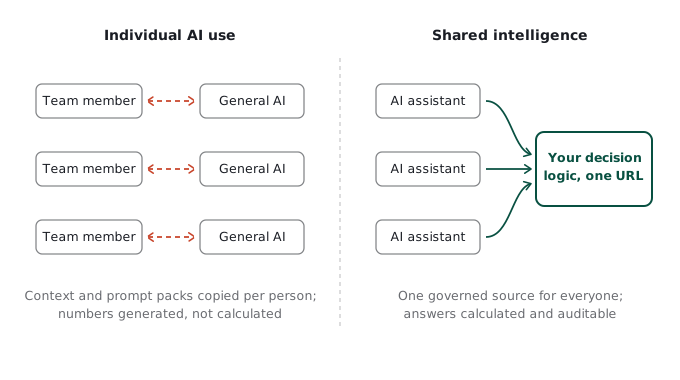
- General AI plus skills training delivers personal productivity, and no more. Every person re-explains the organisation’s context in every conversation, and the numbers in the answers are generated by a language model rather than calculated — good enough for drafting, not defensible for decisions.
- There is still no specialised AI product for project, programme and portfolio management. The leading training teaches general chatbots; established vendors are bolting AI assistants onto enterprise-priced legacy tools; the claim that AI will replace management has no shipped product behind it.
- The missing piece is shared intelligence: your organisation’s own decision logic, placed where every AI assistant can reach it. That is now a small investment, not a platform programme — our proof of concept took roughly half a day of engineering, required no procurement, and stores no data.
Situation: The market offers PMOs coping skills and bolt-on agents, but nothing that changes how the function itself works
The most credible “AI for the PMO” education available today — the House of PMO’s Practical AI Skills course — requires nothing beyond a Copilot, ChatGPT or Gemini account. It teaches augmentation over automation, how to spot fabricated output, and how to live with what the trainers call the “Context Repetition Tax”: re-explaining your governance rules to a tool that cannot remember them. None of that is a criticism. It is the honest state of the art — and it means the best training on offer teaches your people to work around the limits of general tools.
At the vendor end, the pattern is addition, not redesign. Lumivero’s @RISK — the industry standard for quantitative risk analysis in Excel for thirty-five years — now ships an AI agent in beta, priced behind a sales conversation and aimed at the analysts who already use it. The AI extends the existing product; the way the organisation makes decisions is unchanged. And at the loud end of the market, technology executives predict AI will replace management outright — a claim with, so far, no product behind it.
Between coping skills and replacement rhetoric sits a gap: nothing on the market puts your decision logic where your AI can call it.
Analysis: We tested the missing shared layer at two scales — one person, then the organisation — and it costs far less than the market’s pricing implies
The mechanism is the Model Context Protocol (MCP): an open standard, now adopted by the major AI vendors, that lets an AI assistant call external tools instead of guessing. We used it to test the missing layer at two scales.
One person. Our open-source toolkit installs calibrated estimation tools into an individual’s AI assistant with a single command (pmorun-mcp). The assistant carries the conversation; the tool does the arithmetic. Nothing leaves the laptop. Adoption takes minutes — but the value stays with one person.
There is a halfway option: distribute prompt packs or AI skills to individuals, as the training courses recommend. But sharing by copying has structural weaknesses. There is no single source of truth; copies drift silently as people edit them; nobody can say which version produced a number; and updates never fully propagate. The properties shared intelligence needs — everyone on the same version, updates that arrive instantly, usage that leaves a trail — come from connecting, not copying. That is the role MCP plays.
One organisation. We then put the same estimation tool behind a single web address that every assistant in an organisation can reach (public repository). What it took, verifiably: about half a day of engineering; a few hundred lines of code, small enough to audit in a few hours; no stored data of any kind, so no new data-protection surface; and automated tests proving the maths identical to the original.
The genuinely hard part was neither compute nor code. It was the question of who may access the endpoint — identity and access. That is a governance decision, and it deserves to be treated as one.
Evaluation: More licences and more individual AI use buy little; implementing shared intelligence changes what the existing AI spend returns from the ground up
Skills-and-licences spend produces returns that vary by individual and recur with every conversation. Shared intelligence inverts that: codify the method once, and every assistant in the organisation gives the same governed answer. For an executive the difference shows at the point of decision — an estimate produced by calibrated, tested maths can be defended in a steering committee and audited afterwards; a chat answer cannot.
Against the buy option, the contrast is ownership. Bolt-on agents are rented at enterprise prices and live inside one vendor’s product. The pattern we tested is open source, self-hostable and inspectable — the organisation owns the logic and the judgement encoded in it.
Two honest limits. This layer scales calculation and method, not judgement: someone must still decide which decision logic deserves codifying, and that judgement is where the value concentrates. And reaching consumer AI apps — as opposed to the enterprise and developer clients that connect today — requires an identity investment that should be held as its own, separate decision.
Recommendation: Keep the skills floor, then pilot one owned decision tool this quarter
Keep the training; it is the floor, and people need it. But direct the next unit of AI budget at the layer above the floor:
- Pick one recurring, numerical decision the organisation currently answers by gut — estimation is the natural first candidate.
- Put governed logic into individual assistants first. It takes minutes per person and proves the value privately.
- Then pilot one shared endpoint for that single tool. Budget half a day of engineering, keep it storing nothing, and decide deliberately who may connect.
- Judge the pilot on three questions. Do different teams now get the same answer to the same question? Can that answer be audited afterwards? How much more useful did the AI licences you already pay for become?
Hold consumer access and any data persistence as a second, separate decision once usage is visible. The pattern we tested is open source and self-hostable — the only secret involved is a credential you generate yourself.